Friday, 19 March 2010
Body Tattoos
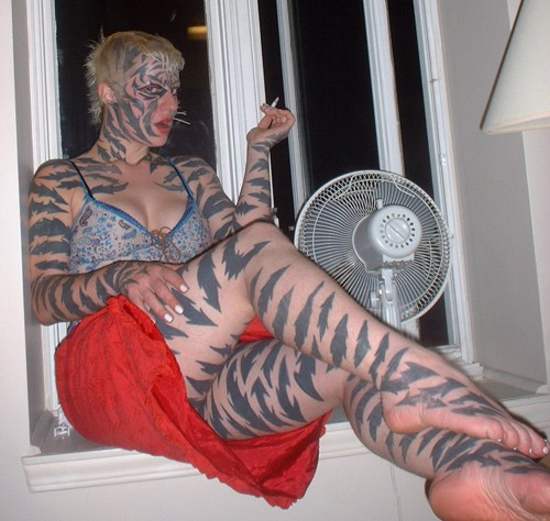
Just about any youngster wants to go out and get him or herself tattooed. This is because tattoos are a way of self expression, that is unique and unlike any other form of self expression. Most youngsters are looking to get a favorite band tattooed on their bodies or even the face of a celebrity, however not many young people know that getting a tattoo removed is very difficult, after all twenty years from now this band is going to be old school and you might be considered a dork if sport a tattoo of a heavy metal band.

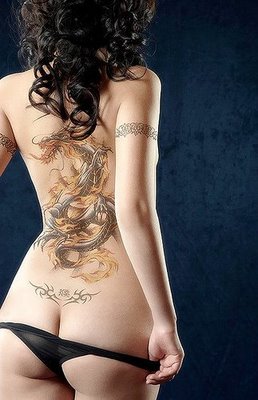
Tattoos are a permanent marking applied to the body by a special instrument and ink. Tattoos are often used as a form of self-expression though it is part of some cultural traditions. There is a large variety of tattoo design, styles, colors, and shapes. Professional tattoo artists often will design an original creation based on the consumer’s request. There is no lack of places on the skin where people have received tattoos. From the head to the toes, tattoo designers and consumers are consistently getting more creative when it comes to getting “inked”.

Tattoos need to be especially cared for to prevent infections and fading. Using sunscreen on the tattooed area does assist with reducing the amount of color fade and an antiseptic cream should be used to cover the entire area immediately after the procedure to promote the healing of the skin. It is possible for the tattoo to be permanently removed but it requires a long, expensive and sometimes painful procedure.
For people who do not wish to have a permanent tattoo placed on their body, there is a wide assortment of fake or temporary tattoos which can be purchased in stores. The tattoos are applied by cutting out the design and using the self-adhesive side of the tattoo to stick onto the skin then completely wet the tattoo with a sponge or washcloth. Apply steady pressure for approximately 30 seconds and carefully peel back the paper backing. The tattoo will remain on the skin from a day to several weeks, depending on what area of the body the tattoo is applied, how often the skin is disturbed by touch, motion, or bathing. The tattoos typically do not wash off with just soap and water but can be removed with baby oil or lotion applied with a cotton ball or washcloth.

Temporary tattoos come in a variety of styles and are often marketed towards younger children and feature popular cartoon characters, animals, and gender-based designs, such as pink flowers for little girls, and sports themes for little boys. Teenagers and adults also have a large selection of popular designs to choose from. There are many designs which are created for specific body regions, such as the neck, ankle, wrists, upper arm and lower back. Tattoos for these areas generally resemble a bracelet-like design which wrap around the area.

Tattoos are a permanent marking applied to the body by a special instrument and ink. Tattoos are often used as a form of self-expression though it is part of some cultural traditions. There is a large variety of tattoo design, styles, colors, and shapes. Professional tattoo artists often will design an original creation based on the consumer’s request. There is no lack of places on the skin where people have received tattoos. From the head to the toes, tattoo designers and consumers are consistently getting more creative when it comes to getting “inked”.
Tattoos need to be especially cared for to prevent infections and fading. Using sunscreen on the tattooed area does assist with reducing the amount of color fade and an antiseptic cream should be used to cover the entire area immediately after the procedure to promote the healing of the skin. It is possible for the tattoo to be permanently removed but it requires a long, expensive and sometimes painful procedure.
For people who do not wish to have a permanent tattoo placed on their body, there is a wide assortment of fake or temporary tattoos which can be purchased in stores. The tattoos are applied by cutting out the design and using the self-adhesive side of the tattoo to stick onto the skin then completely wet the tattoo with a sponge or washcloth. Apply steady pressure for approximately 30 seconds and carefully peel back the paper backing. The tattoo will remain on the skin from a day to several weeks, depending on what area of the body the tattoo is applied, how often the skin is disturbed by touch, motion, or bathing. The tattoos typically do not wash off with just soap and water but can be removed with baby oil or lotion applied with a cotton ball or washcloth.

Temporary tattoos come in a variety of styles and are often marketed towards younger children and feature popular cartoon characters, animals, and gender-based designs, such as pink flowers for little girls, and sports themes for little boys. Teenagers and adults also have a large selection of popular designs to choose from. There are many designs which are created for specific body regions, such as the neck, ankle, wrists, upper arm and lower back. Tattoos for these areas generally resemble a bracelet-like design which wrap around the area.
Lil Wayne’s body tattoos
I don’t really listen to Lil Wayne’s music but I will say that I am somewhat fascinated at his dizzying array of tattoos all over his body. I mean, this guy has just about every part of his upper torso covered in tattoos. Some of the tattoos seem meaningful while others seem like they weren’t thought of at all.
Everytime I see these two photos, I’m like Damn!
Lil Wayne’s body tattoos
Monday, 15 March 2010
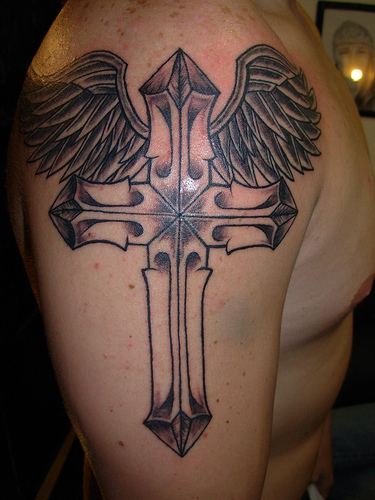
Cross Tattoos
Saturday, 13 March 2010
Butterfly Tattoos
Butterfly tattoos are some of the most feminine tattoos out there for women! Butterflies look great on any curvy part of the part. Their gentle flight, delicate colors and beauty bring feminine charm to any tattoo. Also, there are hundreds of types of butterflies for you to choose from when considering a butterfly tattoo.
Upper back butterfly tattoos look great when you focus on quantity and detail. A collection of many well-placed butterflies mid-way in flight looks great as a full back piece. You can even use your shoulder blades as part of the tattoo design and have them flittering around them. For even more flair, use different types of butterflies to add interest to your piece. A collection of blue swallowtail and monarchs is breath-taking with their bright colors and interesting shapes.
Lower back butterflies look great when you use one large butterfly, or several large butterflies flittering to your hip or thigh. If you want just one large tattoo, a large butterfly stretched across your lower back is an excellent choice. The dip in your lower back is perfect for the natural dip of the butterfly's wings. For some uniqueness, add a splash of tribal lines to further enhance the curves of your butterfly.
Less commonly seen are butterfly tattoos that are on your arms and shoulders. Butterflies going around your biceps can be quite lovely. One of the best butterfly tattoos we've seen was a collection of small butterflies flitting about the back and shoulder of a woman in a sleeve 'tat. Once again, the smaller details highlight the natural feminine curves of your body and the butterflies themselves. It also looked great because it showed off her muscles!
Where can you find inspiration for what type of butterfly you want? I suggest looking at a naturalists' guide to butterflies! Remember, you don't want a moth-like butterfly! We're going to go over which species make great tattoos for their fun colors, and which species you should match together.
The two most common butterfly tattoos are the Blue Swallowtail and the Monarch butterflies. The swallowtails have very long wing tips, and are blue and black. The monarchs are orange and have a lot of black. It's a personal favorite of mine to match these two species because their colors contrast so well, and they even live in the same part of the world! So you're naturally correct when you pair them up too.
Another absolutely stunning butterfly is the Red-Spotted Purple butterfly. It has a lot of blue, purple and a little orange. You won't see many tattoos of this gorgeous less well-known butterfly, so you're certain to get lookers.
Another very unique butterfly is the Zebra Longwing Butterfly. This butterfly is very wide and long, with beautiful Zebra-like stripes running horizontally across it. It would make a wonderful lower-back tattoo, and is very curvaceous. Contrasting one of these beauties with a brightly colored Swallowtail would look absolutely delicious for a tattoo!
Another very uncommon butterfly is the Eleuchia Longwing butterfly. This is a solid black butterfly with a beautiful stripe of white along the outer edge of its wing. Close to its body, it has a wonderful splash of bright red that brings out great color and intrigue. This butterfly would also look great with a Red-Spotted purple or Blue Swallowtail.
Tattoos
Tattoos
So, you need to know about tattoo after care because you are ready to get a new tattoo!
It may be your first time, or it may be your tenth time, but in every case, you should review your tattoo after care instructions prior to getting your new tattoo. You might wonder about the logic about looking at the instructions before getting your new tattoo, but it is like baking a cake, you just don't want to make any mistakes with these instructions because new tattoos are open wounds and susceptible to infection.
You must be attentive to your new tattoo, and keep it as clean as possible to ensure that it heals as cleanly as possible so you prevent infection and end up with the nicest looking tattoo possible.
While the healing stages of a tattoo will be as unique to each individual as there are people in this world, the tattoo healing process does follow a general pattern. The specifics of each tattoo's healing process will depend on the different skin type of the individual, the location of the tattoo on the body, an the techniques of the tattoo artist. These factors can all cause a variance in the healing process from individual to individual.
You will be given aftercare instructions by your tattoo artist. These aftercare instructions differ from artist to artist. My recommendation to you is if in doubt about anything, always go back to your tattoo artist before seeking the help of a doctor. Your tattoo artist can take a look at your tattoo and tell what to do if their is a problem to correct any healing problems.
If your tattoo artist cannot help, they should send you for medical attention from a doctor. If they do not, then of course, you must go yourself to make certain that your health is not at risk. This is your responsibility.
Many times doctors don't know much about tattoos and will prescribe unnecessary medications that may harm your tattoo's healing process. Some doctors may even be biased against tattoos. That is why I suggest that you go to the tattoo artist first if you suspect their is a healing problem with your new tattoo. The artist works with tattoos day in and day out and is familiar with the best way to heal their work.
When you leave the tattoo studio, you will have a bandage on your new tattoo to protect it from outside contact. This bandage should be removed 2- 3 hours after getting your tattoo. Your tattoo may bleed a little for the first 24 hours, remember, your new tattoo is akin to an open wound.
Before you remove your bandage, make sure to wash your hands with soap and warm water, in between the fingers, and under the fingernails. Then dry your hands with a clean paper towel. Do not use any old towel that is laying there, or even a clean towel as lint may be transferred to your hands.
Make sure you have not let a large amount of blood dry on your bandage so that it sticks. Be very, very gentle as you remove your bandage so as not to start the tattoo bleeding again. If you just rip off your bandage, you can mess up the appearance of your new tattoo, and you don't want to do that, now do you?
Wash your tattoo gently, very gently with anti-bacterial soap and water to clean it. Do not scrub your tattoo, do not use a washcloth, or anything else other than your fingers or hand to clean the tattoo. Do not rub, but "pat" the tattoo as you wash it. Then, when you are finished, pat the tattoo dry with a clean dry paper towel. Or, use clean toilet paper even, if you don't have any paper towels on hand.
Let your tattoo air dry for 15 minutes or so. This will promote healing.
After your tattoo has dried, apply a few drops of Emu Oil to your tattoo. The presence of essential fatty acids along with the hyper-oxygenation of Emu Oil naturally increases the circulation to the applied area which is why Emu Oil works so well and so quickly to heal.
Even though it is an oil, it has been proved that Emu Oil does not clog pores (unlike most commercially made tattoo aftercare products that are petroleum based), therefore allowing the skin to breathe during the healing process. Emu Oil penetrates through all seven layers of the skin and is rich in nutrients (essential fatty acids) that feed the skin to aid in new cell development that can hasten the healing process. Emu Oil is also a natural emollient keeping the skin moist and pliable.
The application of the Emu Oil immediately after the tattoo has been cleaned will also relieve the discomfort and reduce the inflammation and redness of the new tattoo. Emu Oil will help set the new colors due to its deep penetrating properties and will help reduce plasma oozing.
Using Emu Oil 2-3 times a day after repeating the cleaning process while the tattoo heals will keep the area moist reducing or eliminating the flaking or scabbing that often occurs as new tattoos heal. Emu Oil can prevent the need for touch ups which saves the artist time and money, and makes for a happy tattoo customer.
New tattoos will look red and swollen immediately following the tattoo procedure. The tattoo will continue to appear this way for a few days throughout the tattoo healing process. Within a week to ten days the skin surrounding the tattoo should be more back to normal - most tattoos are completely healed in three weeks time.
While it is healing it is important not to do the following things or you may damage your tattoo:
- Do Not scratch your new tattoo
- Do Not pick at your new tattoo
- Do Not expose your tattoo to sunlight or tanning beds under any circumstances
- No swimming, hot tubs or baths the first two weeks after getting your new tattoo
- Do Not shave the tattooed area for at least 30 days following the tattoo procedure
- Only touch your tattoo with clean hands, do not let others touch your tattoo
Not only is Emu Oil good for healing new tattoos, it is good for restoring older, aged, sun damaged tattoos as well. This is due to the natural hyper-oxygenation of Emu Oil which brings blood and oxygen to the surface of the skin. This, coupled with Emu Oil's ability to moisturize through all seven layers of the skin, allows users to see quick results when the oil is applied to older tattoos.
With the proper care of your tattoo from the start, there is no reason why you shouldn't enjoy the beauty of your tattoo for a lifetime.
Subscribe to:
Posts (Atom)